

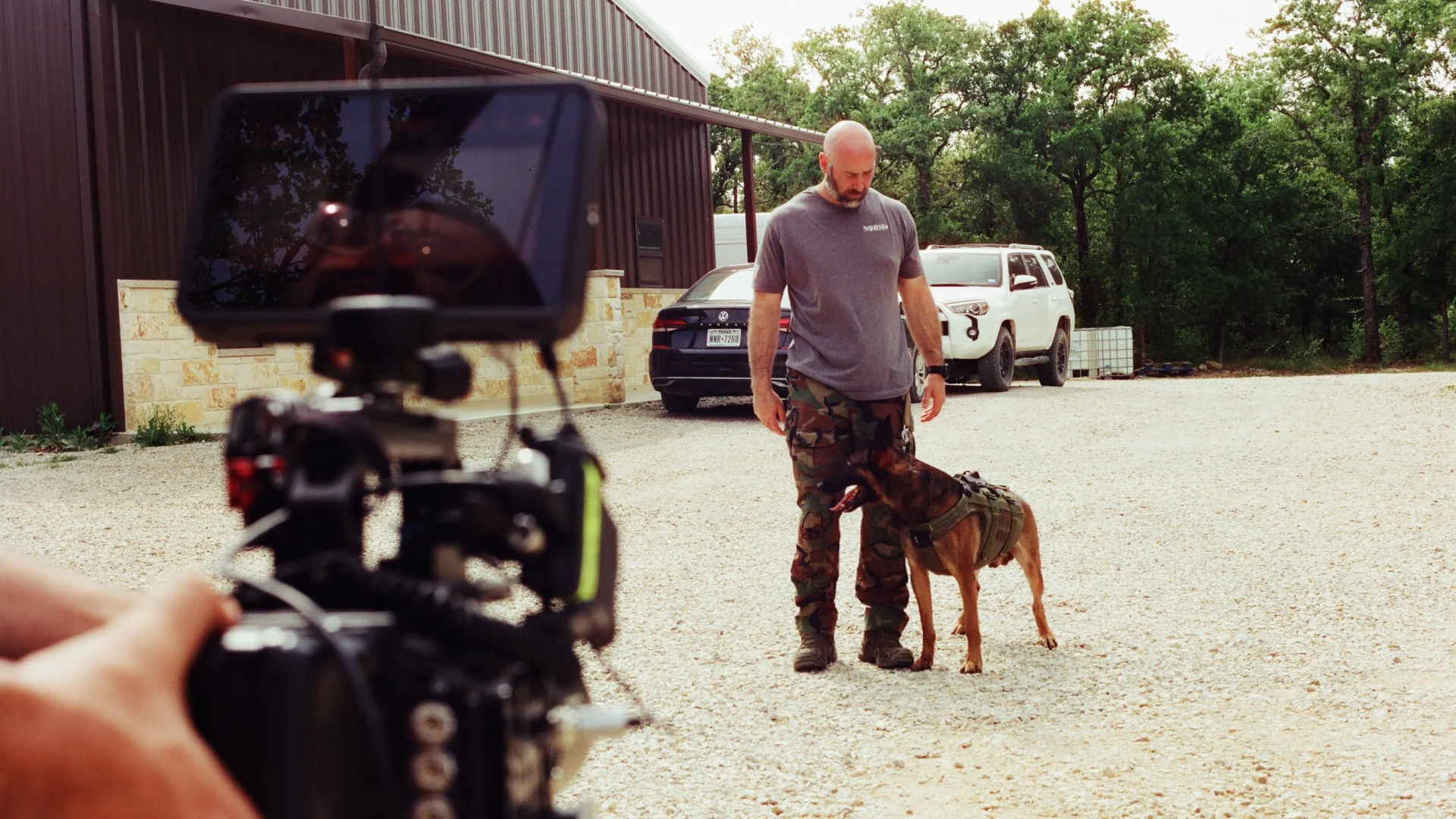
Most working dogs are trained for a world that doesn't exist.
They learn in controlled environments — a decoy in a bite suit, a familiar field, a predictable sequence. The dog learns that when it sees a specific picture, it performs a specific behavior. It looks impressive. It passes certification. And then the dog gets deployed into a real building on a real call, where there is no bite suit and nothing matches the picture it was trained on, and the whole framework can collapse in about two seconds.
In law enforcement, that failure ends up in court. In an active shooter scenario at a school, it ends up somewhere much worse.
This is the problem our client, Joshua Morton, has spent the last eleven years working on.
The Client
Joshua Morton is a former Navy SEAL and the founder of Canine Tactical. He is also, as far as we can tell, the only person in the country doing what he does: cloning a single dog genotype across 43 generations while running a muzzle-based training program built on the premise that the handler's internal state — not the equipment, not the reward, not the commands — is the actual variable that determines what the dog does under pressure.
His position is that conventional training builds dogs that are addicted to something outside themselves. A ball, a suit, a sleeve, a treat. The dog isn't reading the room; it's chasing a feeling. Take the object away, change the environment, and the dog is lost. Joshua's alternative is to strip all of it out, work exclusively in a muzzle, and build from what he calls the dog's truest form — a dog that engages because it perceives what's actually happening, not because it recognizes a trained cue.
He'd been trying to explain this for years. It wasn't landing. The canine community pushed back hard enough that people were making fun of his name online.
The problem wasn't the substance. It was that the work is invisible in words and undeniable on video. You have to see the dog do it.
What We Made
Nine long-form episodes, shot over three days at the Canine Tactical facility in Texas, now live on the Active Shooter K9 YouTube channel.
The subject was a full training week with two law enforcement K9 handlers who traveled in from out of state with their own dogs, working alongside Joshua's cloned Eudoris® line — including E18, the active shooter dog that anchors the entire program, and M1, a clone of a clone carrying E18's imprinted experiences.
The episodes run anywhere from eight minutes to just under two hours, depending on what the day held.
How We Shot It
This was run-and-gun vérité with a strict rule: stay out of the work.
Joshua's training doesn't run on a schedule and can't be blocked out in advance. When we asked what the plan was for a given day, the honest answer was that there wasn't one — he works from what's in front of him and figures out what happened afterward. So we built for responsiveness. Crew on site from 0800h to 1800h, cameras ready before anything started, and no expectation of a shot list.
The rhythm of the work is drill, then debrief. A handler runs a scenario with their dog. It takes ninety seconds. Then everyone sits down in front of a monitor and spends thirty minutes taking apart what happened in those ninety seconds — where the dog hesitated, where the handler's body language cued something he didn't intend, what the dog was actually reading. That rhythm is the entire structure of the training and it became the entire structure of the edit.
We ran multiple camera positions plus the facility's own security camera system, which gave us overhead coverage of the hallways and rooms that no operator could safely capture during a live scenario. Those angles ended up carrying significant weight in the final edit — when Joshua freezes a frame to show a handler exactly where the dog made a decision, that's usually the ceiling camera.
The Format We Landed On
Chronological. Multi-episode. Show everything, trim the fat.
Each episode covers a contiguous block of the actual shoot in the order it happened, with the drill/debrief rhythm preserved rather than compressed. No emotional scoring. No manufactured tension. Where Joshua repeats himself five times working toward a point, we find the strongest instance and cut the other four — but we don't reorganize what he's saying to make it more digestible.
We built a visual grammar to separate the two modes: debriefs run in black and white, drills run in color. The debriefs are Joshua's objective read on what occurred. The drills are the subjective, unpredictable, in-the-moment reality. Once you've watched twenty minutes, you know where you are without being told.
The counterintuitive part is the length. A two-hour episode looks like a mistake by every conventional content metric. But this audience isn't scrolling — they're studying. A K9 handler is going to pause, rewind thirty seconds, and watch a correction three times to understand what Joshua saw. The repetition and the duration aren't obstacles to that audience. They're the product.
We time-stamp every episode with chapter markers so viewers can navigate directly to the drill or the concept they're after, and we handle upload, titling, description, and thumbnail direction directly on the client's channel. Joshua's expertise is dogs. Ours is making sure the right people find the work.
Interested in a long-form documentary project for your business? Schedule a call.
